

 Télécharger l'article
1 Introduction
Linguistic diversity is a general feature of immigration societies – even if they consider themselves as monolingual (as is the case in most European nation states). Consequently, the education systems care for a good development of the national language(s). Most European countries also care for a command of English as lingua franca by foreign language teaching. In that sense, the next generations of Europeans will (at least) be bilingual. But this in no way captures the actual linguistic diversity in Europe. People from virtually all countries in the world live in Europe and cultivate their heritage languages more or less intensively. The linguistic wealth inherent in these languages is not supported or encouraged by most national education systems.
Against this backdrop, a longitudinal study entitled Multilingual development over time (The MEZ-Study)1 was carried out in Germany, i.e. one of the European societies facing major immigration movements since World War II. The study was focused on the questions if and how students’ multiple literacy competencies develop over the course of secondary schooling. Language development of roughly 2.000 students was observed in four measurements over three years of schooling; from more than half of the sample, data from additional two waves is availbale. All students were tested in German as well as English, the first foreign language nearly all students learn at a German school. Roughly half of the MEZ sample were tested in Turkish or Russian, if this was their family’s heritage language. Furthermore, about 40 per cent of the sample were also tested in French or Russian if one of these languages was the second foreign language they learn at school. To our best knowledge, design and data of the MEZ study are globally unique to date, as the data includes reading and writing competence in at least two, a maximum of four languages of each individual participant, furthermore extensive background data concerning factors that have an impact on language development and performance.
In this article, we present the design of the project, in particular methods for measuring skills in multiple languages and the associated methodological challenges. Furthermore, we include examples of analyses with the available data in order illustrate the range of possibilities. We invite to further research based on the MEZ data treasure of tests and background information – a corpus of approx. 17,000 student texts is available to the research community for re-use.
2 Context: Germany as an immigration country
For decades, Germany has been one of the most attractive destinations for international migrants. In 2023, for example, roughly 25 million international migrants lived in Germany; this corresponds to 29.7 per cent of the population. The proportion of children and young people (up to the age of 20) was at 42.2 percent in 2023 (Statistisches Bundesamt 2024). Roughly 39% of students in compulsory education grew up in families with a migrant background. In urban areas, this share tends to exceed 50 percent (Autorengruppe Bildungsberichterstattung, 2022, p. 143, Figure D4-2). “Students with a migrant background” are by no means “a minority” in Germany’s education system. Migrants in Germany represent about 190 countries of origin, i.e. nearly all officially recognized countries of the world. There are (as yet) no reliable statistics on the number of languages spoken in Germany; it is more than likely, however, that at least in cities and urban areas, 200 or more languages are in daily use, just as in London, New York or Sydney…
More than 45 percent of first- and second-generation immigrant students have a very low socio-economic status. In this respect, Germany shows similarly high levels of disadvantaged students as, for example, the Netherlands, Sweden, or Finland (OECD, 2019). According to large scale studies, performance disparities between migrant and non-migrant students are particularly high and remain significant even after controlling for socio-economic status (e.g., Teltemann & Rauch, 2018). As the PISA studies show since more than two decades, Germany belongs to the countries in which immigrant students who use a language other than the language of instruction at home are significantly disadvantaged, in their reading performance (OECD, 2019) as well as in science and mathematics (OECD, 2023).
3 Multilingual competences – risk, resource or irrelevant?
There is a popular quick answer to the question of reasons for immigrant students’ disadvantage in education: being multilingual is a risk to educational success. One aim of the MEZ study is to test this assumption. Without doubt, language skills are key for social participation and educational attainment. However, ongoing controversies are sparked by the question of whether multilingualism is a resource, a risk factor or irrelevant for educational success. This question is not raised if the learners are members of well-off or privileged families. In the case of “average” immigrants as well as autochthonous minorities however, the relevance of the parents’ or families’ heritage languages is disputed (Edele et al., 2023; Gogolin and Neumann, 2009). In large scale international performance studies such as PISA, PIRLS or TIMSS, the learners’ use of languages other than the languages of schooling – which is usually the main language of the residence area – is associated with performance disadvantages (e.g. OECD, 2019; Stanat & Edele 2015). Interestingly enough, actual language related parameters (e.g. the question of the type and extent of heritage language skills) remain unaddressed in these studies. The message however, that bi- or multilingual living conditions have to be regarded as risk factor for educational achievement, has had a resounding impact on education policy and the public opinion in many countries – such as Germany.
One starting point for initiating the MEZ study was the interest in empirically testing the substance of this interpretation. Previous studies have indicated clearly that information on the language(s) used in the families does not answer the question of the influence of language on educational attainment, but primarily contains information on living conditions of the respondents, e.g. with respect to their interaction with members of the autochthonous population. For the MEZ study, we assume, that evidence on the degree and type of language proficiency is necessary in order to draw conclusions about the effects of bi- or multilingualism on educational attainment. It is a major problem in this respect that language proficiency, in particular proficiency in heritage languages, is hardly ever measured. Respective information is often based on self-reports or on observations in small scale studies. The validity of resulting findings is limited.
With the MEZ study we intend to contribute to closing the gap. We focus on the degree of literacy that pupils acquire in the language of schooling, in foreign languages taught at school and migrants’ heritage languages – e.g. multiliterate competence. Advantages of growing up with two or more languages have been shown in different areas, e.g. of cognitive development (e.g. Antoniou, 2019; Bialystok & Poarch, 2014; Giovannoli et al., 2020). Such advantages are likely to create favorable conditions for learning in general and language learning in particular, but there are still contradictory findings about the effects of multilingual living conditions on pupils’ attainment (Rauch, 2014; Maluch & Kempert, 2019). Based on MEZ data, we aim to show how multilingual literacy skills develop in pupils of advanced school age2 and which conditions hinder or facilitate the successful development of respective skills.
In our study, the term multilingualism encompasses
- a lifeworld (lebensweltlich) constellation, i.e. cases in which learners grow up and live in more than one language and acquire their skills in such informal contexts; these are often pupils from migrant families.
- a foreign language constellation, i.e. cases in which learners live and grow up in monolingual conditions but experience multilingualism by learning at least one foreign language at school, regardless of their everyday language use.3
In this understanding, all learners in German schools develop forms of multilingual competence. Consequently, the MEZ studies differentiate between the two ideally distinguishable groups of multilingual learners: those with experience of multilingualism in a foreign language and those who are multilingual in their everyday life, but also learn foreign languages at school (cf. Gogolin et al., 2017). This apprehension of multilingualism refers to the circumstances of language acquisition and the development of language repertoires. It is complementary to the consideration of the type of language use in the context of linguistic diversity, for which the term plurilingualism has become established. The concept of plurilingualism is embedded in activities of the Council of Europe, which draw attention to the fundamental equality of languages and aim to promote the appreciation of individual linguistic abilities through appropriate teaching opportunities (Beacco & Coste, 2018).
4 The MEZ study design4
The MEZ study tracked pupils with monolingual German, German-Russian and German-Turkish language backgrounds over a total of six survey waves. Productive (writing), receptive (reading) and holistic language skills were tested in German as the language of schooling and the environment, in Russian and Turkish as heritage languages, in English as the first foreign language at school and, where applicable, in French or Russian as second foreign languages. In addition, in-depth insights were gained via student and parent questionnaires, e.g. about their socio-economic conditions, migration biographies, language practices, attitudes towards multilingualism and educational aspirations. Furthermore, a questionnaire for school management explored characteristics of the schools’ demographic constellation and information about their language related programs.
Figure 1: MEZ study design
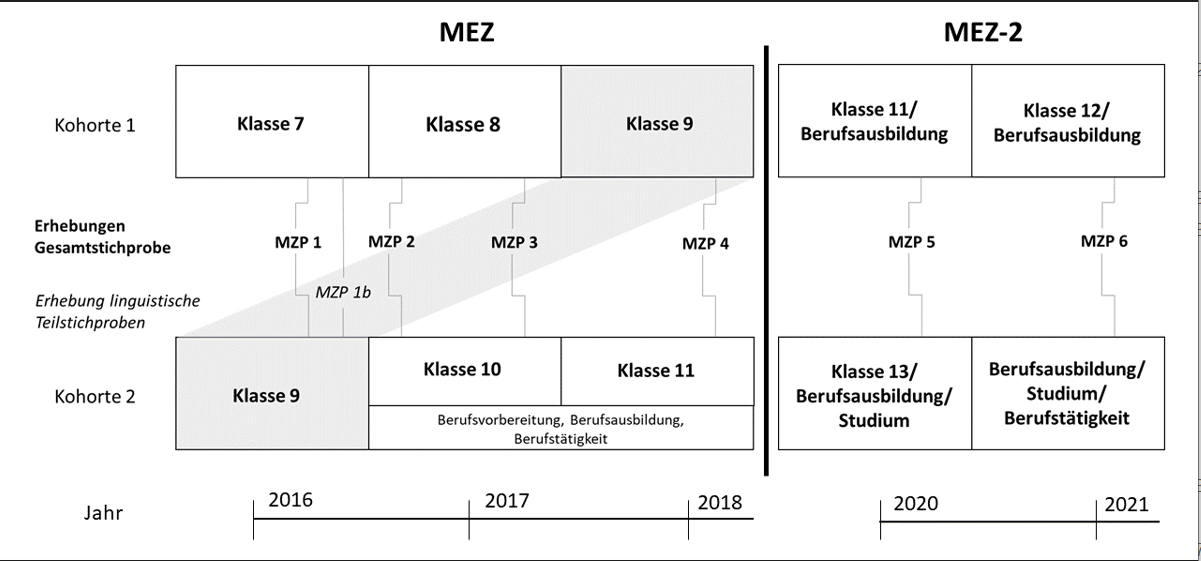
MEZ applied a two-cohort panel study: cohort 1 included pupils in 7th grade, i.e. 13+ years old; cohort 2 included pupils in 9th grade, i.e. 15+ years old. The starting sample comprised of 2103 pupils at 78 schools in different German federal states. Sampling was theoretically based, i.e. not aimed at representativity, but at participants with the following characteristics (Klinger et al., 2022):
1. pupils with a German-Russian, German-Turkish or monolingual German background who received instruction in English as a first foreign language and, if applicable, French or Russian as a second foreign language;
2. pupils in the seventh or ninth grade;
3. pupils who attended a school in Germany since at least the third grade (i.e. age 7+).
All pupils attended schools for middle or high achievers. Participation in the study was voluntary for schools, parents and pupils. The resulting sample is substantial, but not representative.
All pupils were tested in German and English; those with a Russian or Turkish as heritage language were also tested in these. Pupils with French or Russian as a second foreign language took additional tests in these languages. Cognitive potential was tested once with a non-verbal test (subtest of KFT 4 -12 + R, Heller & Perleth 2000; cf. Klinger et al. 2022). In MEZ-2, two additional survey waves (2020 and 2021) were carried out with a remaining gross sample of 1133 participants at the transition to upper secondary level or a vocational qualification. MEZ-2 included tests for German, Russian or Turkish, and English. The MEZ-2 data collections were carried out online.5
The MEZ testing of language skills is focused on literacy in both dimensions: the ability to write as well as reading ability. This sets the MEZ design apart from other large-scale studies or studies such as PISA or PIRLS that limit themselves to measuring reading skills. For writing skills, we adapted a test called "Fast Catch Boomerang" (Reich et al. 2009; Dirim & Döll 2009) and developed parallel forms for each language (“MEZ-Schreibaufgaben”). Reading skills were tested with parallel forms of a standardized instrument for measuring reading speed and reading comprehension (LGVT 5-12+; Schneider et al. 2017). Russian and Turkish adaptations of the test were developed in collaboration with the authors (Schlagmüller et al., 2022). Foreign language skills (English, French, Russian) were tested with C-tests (Grotjahn 2002). For English, existing tests were used (Bos et al. 2009; Bos & Gröhlich 2010). These were adapted for French and Russian (Klinger et al. 2022).
5 Challenges of measuring language development
Most of the available statements on language development are based on cross-sectional studies of different age cohorts. This approach allows to identify trends, but no causal conclusions. For causality, genuine long-term studies are necessary, i.e. studies with repeated measurements of the same individuals. It is a major challenge of repetitive measurement that instruments that are tried and tested for cross-sectional studies are not necessarily suitable for longitudinal approaches. In addition to general quality requirements, tests for longitudinal studies must meet the criterion of longitudinal measurement invariance (Barkaoui, 2014; Nagle, 2022): They have to work in identical way in repeated measurement, i.e. the conditions of testing have to be irrelevant for the tested construct itself (Millsap, 2011).
In order to model and test the psychometric validity of the MEZ tests, longitudinal confirmatory factor analyses was applied (Little, 2013). Longitudinal measurement invariance is defined in this framework as factorial invariance over time. Four levels of factorial invariance are distinguished (Cheung & Rensvold, 2002): (1) confirmatory (the construct is measured in a structurally comparable way); (2) metric (the construct is measured on the same scale); (3) scalar (the scale has the same zero point over time), and residual (the construct is measured with the same reliability over time). Metric and scalar measurement invariance are relevant for the interpretation of the measured values in MEZ. The tests we performed confirm the necessary quality for all instruments.
Writing tasks
Writing skills were measured using the "MEZ-Schreibaufgaben" (Gogolin et al., 2022, Klinger & Schnoor, 2020, Klinger et al., 2024) in German, Russian and Turkish. The task is writing an instructional text for the construction of a wooden boomerang, based on nine photos of the procedure. Parallel forms with varied topics were developed for longitudinal use in MEZ in order to mitigate training and motivation effects (Gogolin et al., 2022, Klinger et al., 2022; Schnoor, 2022). Each parallel version follows the same construction and evaluation principles.
For the analysis, a generic model was developed for all versions of the elicited texts (Gogolin et al., 2022; Klinger et al., 2024). It is based on the writing research (Puranik et al., 2008; Wagner et al., 2011), focusing on three areas of competence: textual-pragmatic, lexico-syntactic qualifications and productivity. Together, these competencies form a uniform construct that reflects the quality of the written texts. The competence areas are represented by the following empirically determined categories: Task accomplishment (textual-pragmatic qualification: degree of completeness and elaborateness of the rendition of the plot); nouns, adjectives, verbs (lexico-syntactic qualification: differentiated use of lexical means in the text); conjunctions (lexico-syntactic qualification: cohesiveness); educational language elements (lexico-syntactic qualification: degree of appropriation of terms typical of school tsasks) and number of words (productivity). These categories form the construct of writing skills in all languages studied in MEZ.
In psychometric respect, the writing task proved to be unidimensional in all languages and survey waves, with high internal consistency of the scale (Cronbach's α ≥ .84) and inter-rater reliability (ICC ≥ .87). The construct is therefore perfectly suited for cross-sectional analyses. With respect to validity in longitudinal models, the indicators task mastery, verbs, sentence conjunctions and productivity proved to be metrically invariant over time. The tests are therefore structurally comparable, in each wave skills are measured on the same scale and are thus suitable for covariance analyses (Klinger & Schnoor, 2020). Furthermore, scalar longitudinal invariance is achieved by further invariance restriction to the task mastery indicator. This model version is suitable for mean value comparisons. Both model versions also prove to be invariant between the age cohorts.
Reading tasks
The standardized reading test LGTV 5-12 is designed to measure three dimensions of reading ability: reading comprehension, reading speed, reading accuracy. It was developed for testing in German in grades 5 to 12. The test offers parallel versions for multiple testing. Adapted versions for Russian and Turkish were created by MEZ in cooperation with the test authors. In Russian, a version in Latin script was offered in addition to the Cyrillic version. In MEZ-2, the data was collected via online testing. In psychometric terms, the scale for reading comprehension proved to be largely satisfactory; internal consistency across the survey waves for German is between α = .82 and α = .90; for Russian (Cyrillic) between α = .84 and α = .90; for Russian (Latin) between α = .04 and α = .65; for Turkish between α = .64 and α = .83). The test versions are therefore suitable for cross-sectional analyses.
Holistic language ability
Foreign languages English, French and Russian, "holistic language ability" was tested with C-tests (Grotjahn 2002; Schnoor et al., 2023; Klinger et al., 2024). A C-test consists of four texts in which the second half of every third or fourth word is deleted. The test makes use of the property of readers to ignore redundant information and understand content even if it is not given in full. The ability to reconstruct meaning based on redundant information is used as an estimate of "holistic language ability". In MEZ, a C-test consists of four independent texts (approx. 100 words each) with 20 gaps (Rosenbaum, 1988; Wainer & Kiely, 1987). In psychometric respect, the C-test scale proved to be unidimensional with very high reliability in all languages and waves (internal consistency of α ≥ .90). Longitudinal measurement invariance has only been tested for English so far. Here, the highest level (residual measurement invariance) is achieved. Change in C-test results over time is therefore due to the actual change in language competence in English (Schnoor et al., 2023).6
6 Selected results
Multilingual writing skills
A single theory that offers a consistent and comprehensive explanation of multilingual writing development does not exist to date (Gogolin et al., 2022; Chung et al., 2019). However, a combination of theoretical approaches contains the most important building blocks for framing our research on multilingual writing development:
The Focus on Multilingualism approach (FOM, Cenoz and Gorter, 2011) emphasizes the need for simultaneous consideration of skills in all languages as components of the multilingual repertoire. Accordingly, (1) the languages acquired in the family and those learned at school, (2) the interrelations between the languages and (3) characteristics of the acquisition contexts must be taken into account. This approach is based on the Complex and Dynamic Systems Theory (CDST; De Bot, Lowie, & Verspoor, 2007; Hiver & Al-Hoorie, 2020), which views language development as a complex, interdependent and dynamic system. The Translingual Model of Writing Development (Canagarajah, 2015) applies this basic idea to multilingual writing ability. According to this model, writing develops simultaneously, continuously, non-linearly, multi-directionally and with various possible interlingual influences, which can be attributed to the existence of a cross-linguistic basic writing competence (cf. also Cummins, 1979, Cummins, 2000).
These perspectives form the basis for analyses on multilingual writing skills, carried out on the basis of MEZ data.7 The complexity of multilingual writing repertoires was at first examined cross-sectionally, including data in German, English, Russian or Turkish from 805 German-Russian and German-Turkish pupils. In this step, latent profile analyses revealed three multiliteracy profiles among the pupils: they performed (A) below-average, (B) slightly above-average or (C) very high above average in all their languages (Usanova and Schnoor, 2021). This provides evidence that writing skills in the different languages are not in competition with each other.
The next question, whether the languages can therefore also act as reciprocal resources for writing development, was subsequently investigated using longitudinal MEZ data (Schnoor and Usanova, 2022). In this step, the multilingual writing data of 965 German-Russian and German-Turkish students from the first three MEZ waves were estimated using longitudinal structural equation models. This analysis revealed dynamic developmental trajectories with exclusively positive reciprocal influences between the languages. These results support the assumption that the literary skills of multilinguals are not only based on their experiences and skills in each single language, but also on cross-linguistic factors (see also Usanova & Schnoor, 2022; Usanova, Schnoor & Gogolin, 2023). The MEZ study thus provides clear evidence that multilingualism can serve as a resource for the promotion of literacy as a whole. To date, however, cross-linguistic and cross-disciplinary concepts for systematic promotion of writing skills involving multilingual resources are still missing (cf. Busse & Hardy, 2023).
Contextual conditions for multilingualism as a resource
The development of skills over the course of education is influenced by a variety of individual and contextual factors. For the MEZ study, data on factors that are likely to influence the development of respective skills were collected. In the following sections, we present three examples of data analyses: (1) on the question of how social relationships with peers influence the individual level of multilingualism; (2) on the pupils’ perceptions of the usability of multilingual skills on the labor market, and (3) on possible connections between multilingual skills and emotional well-being.
Peer relationships
General models of language acquisition show that everyday interaction under conditions of status equality and cooperation are particularly favorable for the acquisition of language skills (e.g. Esser, 2006). Such contacts are characteristic of peer relationships. Peers become increasingly important in the course of adolescence (Zander et al., 2017). There has been a lack of research into the role that integration into inter- or intra-ethnic peer networks plays in the development of young people's language skills. For the MEZ study, a questionnaire was developed (cf. Dünkel & Knigge, 2019) that focuses on friendships as contexts for language acquisition and language use in German and the heritage languages. Additional information was collected on the linguistic composition of the circle of friends, the language background of best friends and language use with them. Participants were also invited to assess their friends' abilities in German and the respective languages of origin.
The information provided was analyzed using cluster analyses. This revealed three types of friendship groups in the sample: heritage language-oriented, linguistically heterogeneous and monolingual German-oriented (Dünkel, 2022). In regression analyses, these types were used to predict the reading performance of the “lifeworld multilingual” adolescents in German and their language of origin. As expected, it was found that the extent of access to monolingual German friends and the use of German among friends are positively related to reading performance in German and help to explain performance disparities between the multilingual and monolingual adolescents. With regard to reading in the language of origin, there are indications with marginal significance that pupils with a Turkish language background in particular benefit from circles of friends oriented towards the heritage language, additionally to the use of Turkish with their parents.
In a further study, Dünkel et al. (2024) investigate the extent to which involvement in linguistically differently oriented circles of friends contributes to explaining different multilingual profiles. Based on median splits of multilingual pupils’ reading performance in German and the languages of origin (Russian and Turkish), four competence profiles were identified: A) advanced bilingual readers, B) advanced readers in German, C) advanced readers in the language of origin and D) below-average bilingual readers. Multinomial logistic regression analyses show that "best friendships" with monolingual German and heritage language peers are associated with both higher reading performance in German (profile B) and higher bilingual skills (profile A). Furthermore, there are indications that advanced multilingual readers benefit from friendships with their peers who are assessed as competent in heritage languages. Nevertheless, the more frequent use of heritage languages with parents proves to be the decisive predictor for higher heritage language reading performance.
In any case, high reading performance in the heritage language does not constitute an obstacle to higher performance in German. The analyses of peer relationships lead to the conclusion that the linguistic composition of friendship groups is not only relevant for oral language development, but also for the development of literary skills. Furthermore, in these (as in the other MEZ) analyses, no negative influence of heritage language skills on the performance in German can be found: obviously, there is no competition between high multilingual skills and the development of high skills in German.
Expectations about multilingualism on the labor market
For young people approaching the end of their schooling and the transition to a career in the labor market, ideas about their own professional future offer a further perspective on possible factors influencing the development of language skills. In recent years, the use of languages other than German in the workplace occurs at all levels of qualification and in all occupational fields. English is the most frequently requested additional language, but migrant languages such as Russian or Turkish are also in demand on the labor market (Brandt and Lagemann, 2022). Multilingual skills in foreign and heritage languages can therefore be an advantage when it comes to career opportunities. Since English is taught to (almost) all pupils in Germany from elementary school onwards, English language skills have lost their distinctive importance, whereas proficiency in another language in addition to German and English can make a significant difference.
Based on a rational choice perspective, it can be assumed that students' anticipated usability of multilingual skills on the labor market has an impact on their actual skills and trigger corresponding investments. However, there has been little research to date into the extent to which learners are even aware of the potential labor market advantages of multilingual skills. Against this background, data from the first MEZ wave was used to gain an impression of pupils’ views on the relevance of English skills for their own professional future (Lagemann, Brandt & Gogolin, 2017). Here, English was unanimously considered to be of substantial importance for the professional future. Multilingual pupils rated the importance of English for their career even higher than their peers from monolingual German-speaking families. All students rated written skills in English as well as the heritage languages Turkish and Russian as less important for their professional future than oral skills. There was also a significant and positive correlation between the importance that students attached to English for their professional future and their test results in English.
In analyses of data from the third MEZ wave, the finding that multilingual pupils attribute greater relevance to English skills in the labor market than monolingual German speakers was confirmed (Brandt & Lagemann, 2022). Here, too, heritage language skills were considered less important than English by the multilinguals. Just over half of them considered proficiency in their heritage languages to be important for their personal professional future. In regression models that controlled for relevant background variables, multilingual (but not monolingual) respondents showed a significant correlation between the perceived benefit of English for their own professional future and their measured English skills. The perceived labor market benefits of skills in Russian and Turkish were also significantly and positively related to the students' measured heritage language skills.
The follow-up study MEZ-2 looked at the role of multilingual resources in the transition to vocational or academic training (BaužytÄ & Pershina, 2024). Regardless of whether they were monolingual or multilingual, the majority of respondents still consider their English language skills relevant for their professional career. Here too, they attached the highest value to their oral skills. The languages of origin were again rated as less relevant by the multilinguals. More than half of the respondents stated that they use English in their studies or vocational training. Roughly 30 percent of the German-Turkish and German-Russian group reported using their language of origin in vocational training.
The analyses show that both groups, multilingual and monolingual MEZ respondents, are well aware of the relevance of multiple language skills for the labor market, in particular English. The data also shows that the perceived usefulness of multilingual skills for their own professional future and their actual skills in respective languages are linked. On the one hand, this provides a good starting point for motivating young people to invest more in their language skills. On the other hand, it shows that no considerable efforts had been made to promote their appreciation of multilingual skills. The respondents' valuation that oral skills (in all the languages included in the analyses) are more important for their professional future than written skills, is not in accordance with employers’ ideas. Respective studies demonstrate that monetary advantages of multilingual skills arise in particular from literacy in addition to oral skills (Stöhr, 2015; Rumbaut, 2014). In this respect, it would be advisable for schools to inform their pupils more thoroughly about the potential of multilingual skills in the labor market.
Multilingual skills and emotional well-being
In addition to issues of educational success, language skills are also seen as important for emotional well-being, and vice versa: well-being is considered to be conducive to the development of language skills. However, little is known about multilingualism as a resource for well-being. Research shows that opportunities to use multilingual repertoires in the social environment are relevant for well-being. Connections between multilingual skills and well-being are particularly explicit in processes of identity development in adolescence (Aronin, 2020; Blommaert et al., 2005). Various questions relating to well-being were included in the MEZ background questionnaires, e.g. items on subjective well-being and the Big Five Inventory (Rammstedt et al., 2020) which correlates strongly with well-being in the personality dimensions of neuroticism and extraversion (Mann et al., 2021; Vittersø & Nilsen, 2002). In MEZ-2, the Standard Stress Scale (Gross & Seebaß, 2016) and the Child and Youth Resilience Measure (Liebenberg et al., 2012) were additionally implemented.
In a first approximation of correlations between multilingualism and well-being, self-assessment data on their skills in German, English and the heritage languages Russian and Turkish were used, data collected in MEZ-2, wave 6 (Ticheloven & Blom, forthcoming). The analyses show a statistically significant correlation between a good command of the heritage language and positive emotions. For German, low self-assessed abilities are associated with higher values of negative affect (in the dimensions of shame and guilt) and with lower life satisfaction. For English, no significant correlations were found between self-assessments and well-being. Accordingly, English seems to play a major role in the adolescents’ career-related expectations, but not in their personal well-being. Positive or negative emotions are rather associated with the heritage languages and German. These initial observations suggest that correlations between well-being and language skills are dependent on the social context, as has been found in other studies (Colón-Quintana et al., 2022; Kleinkorres et al., 2020). Analyses using the full potential of the MEZ data, namely investigations into correlations between measured competences, self-assessment data, data on well-being and other background information, have not yet been completed at the time of writing this article. We are confident however, that further analyses will explain the relationships between multilingual skills and well-being much more precisely than the current state of research reveals.
7 Potential for further analyses
The MEZ studies provide a wealth of complex language data as well as data on individual and contextual factors that can influence the development of multilingualism. A considerable number of analyses have already been carried out and published (www. mez.uni-hamburg.de/publikationen). However, this by no means exhausts the potential of the data. From the outset, it is one of the studies’ aims to contribute to Open Science. Consequently, the data has been prepared for subsequent use and is available to the research community.8
The available data provides a view of the complexity of individual multilingualism and its development: skills in different languages and modalities (reading, writing) can be analyzed in their connection to each other and in how they change over time. In addition, the data allow insights into linguistic, personal and contextual conditions that influence the acquisition of multilingual competences, as well as their interrelationship with other dimensions of educational performance. And last but not least: The systematic inclusion of pupils with German as their only heritage language allows to draw conclusions that can be applied to adolescents with and without the experience of multilingualism in their everyday lives.
The MEZ study shows that methods in the quantitative paradigm can be used to gain differentiated and in-depth insights into processes and the (always provisional) results of multilingual development. Furthermore, the results already available show that it is worth taking a differentiated look at the linguistic situation in the context of linguistic diversity - not only with regard to descriptions of multilingual environments or explanations for more or less successful language acquisition, but also with regard to principles that are useful for language education policy decisions and the design of constructive teaching-learning processes that promise success in the context of linguistic diversity.
One of the most significant global findings of the MEZ studies is that there is considerable potential for multilingual literacy skills among pupils with a migrant background. These include skills in the languages of origin, which is by no means self-evident given the fact that less than 10 per cent of these adolescents benefit from lessons in these languages as part of public education programs in Germany (Mediendienst Integration 2022). This shows that many immigrant families make considerable private investments in promoting their children's multilingual competences. At the same time, the analyses show that these investments in no way jeopardize German language skills (which are essential for educational success and participation): German is the most pronounced language of literacy among all MEZ youngsters - which was to be expected.
Our evaluations also suggest that the development of literacy is based on cross-language skills on the one hand and language-specific skills on the other. Corresponding indications have already been found in other studies, as reported above. It can therefore be expected that schools’ investment in the systematic promotion of cross-linguistic skills can provide an additional benefit for the development of literacy in the individual languages. This benefit will be based on various factors - including the fact that recognition and promotion of heritage language skills has a positive influence on the socio-emotional well-being of learners from migrant families. There is apparently no need to fear that openness to multilingualism will have negative consequences for the well-being of monolingual learners (Möller et al., 2017).
In addition to numerous possible further analyses of the MEZ data, intervention studies that test and examine programs based on the actual linguistic resources of young people to promote multilingual literacy skills would be useful. The MEZ project provides worthwhile starting points for such studies - not least through the existing tests for measuring multilingual skills, which were tested for quality and suitability in the course of the project, or other tried and tested instruments that help to clarify the relationship between the development of multilingualism, the factors influencing it, and education.
Literature
Aronin, L. (2020). Dominant language constellations as an approach for studying multilingual practices. Dominant Language Constellations: A New Perspective on Multilingualism, 19-33.
Antoniou, M. (2019). The Advantages of Bilingualism Debate. Annual Review of Linguistics, 5(1), 395-415. https://doi.org/10.1146/annurev-linguistics-011718-011820
Balkenhol, A. (2016). Reading in professional contexts - requirements, processes and diagnostics. Darmstadt. ULR: http://tuprints.ulb.tu-darmstadt.de/5209/1/Lesen%20im%20beruflichen%20Handlungskontext.pdf)(as at: 26.6.2017)
Barkaoui, K. (2014). Quantitative approaches for analyzing longitudinal data in second language research. Annual Review of Applied Linguistics, 34, 65-101.
BaužytÄ, K., Pershina, K. (2024). Language orientations at the school-to-work transition. Information from the study "Mehrsprachigkeit an der Schwelle zum Beruf" (MEZ-2). University of Hamburg. Hamburg. (MEZ working paper, 16). Available online at: https://www.mez.uni-hamburg.de/files/arbeitspapier-16.pdf, accessed: 21.06.2024.
Beacco, J.-C., Coste, D. (2018). L'éducation plurilingue et interculturelle. La perspective du Conseil de l'Europe. Paris (Didier).
Bialystok, E. & Poarch, G. (2014). Language Experience Changes Language and Cognitive Ability. Journal of Educational Science, 17(3), 433-446. https://doi.org/10.1007/s11618-014-0491-8
Bos, W., & Gröhlich, C. (Eds.). (2010). KESS 8: Competencies and attitudes of students at the end of grade 8. HANSE - Hamburger Schriften zur Qualität im Bildungswesen (Vol. 6). Waxmann.
Brandt, H., Lagemann, M. (2022). Language Demands of the Labor Market: A Predictor of Students' Investments into Multilingual Skills? In H. Brandt, M. Krause & I. Usanova (Eds.), Edition ZfE: Vol. 11. Language Development in Diverse Settings: Interdisciplinary Results from the Project "Multilingualism Development over Time" (MEZ) (pp. 133-166). Springer VS.
Busse, V., & Hardy, I. 2023. "Literacy and multilingualism: Definition, approaches and research findings." Teaching Science 1: 1-20. doi: 10.1007/s42010-023-00175-0 .
Canagarajah, S. (2015). Clarifying the relationship between translingual practice and l2 writing: Addressing learner identities. Applied Linguistics Review, 6(4), 415-440. https://doi.org/10.1515/applirev-2015-0020
Cenoz, J., & Gorter, D., (2011). Focus on Multilingualism: A Study of Trilingual Writing. The Modern Language Journal, 95(3), 356-369. https://doi.org/10.1111/j.1540-4781.2011.01206.x
Cheung, G. W., & Rensvold, R. B. (2002). Evaluating goodness-of-fit indexes for testing measurement invariance. Structural Equation Modeling: A Multidisciplinary Journal, 9(2), 233-255. https://doi.org/10.1207/S15328007SEM0902_5
Chung, S. C., Chen, X., & Geva, E. (2019). Deconstructing and reconstructing cross-language transfer in bilingual reading development: An interactive framework. Journal of Neurolinguistics, 50, 149-161
Colón-Quintana, N., Polo, A. J., & Smith Carter, J. (2022). The reciprocal effects of language proficiency and depression among low-income Latinx youth. Journal of Clinical Child & Adolescent Psychology, 51(1), 112-126.
Cummins, J. (1979). Cognitive/academic language proficiency, linguistic interdependence, the optimum age question and some other matters. Working Papers on Bilingualism, 19, 121-129.
Cummins J. (2000). Language, power and pedagogy: Bilingual children in the crossfire. Clevedon: Multilingual Matters.
De Bot, K. de, Lowie, W. & Verspoor, M. (2007). A Dynamic Systems Theory approach to second language acquisition. Bilingualism: Language and Cognition, 10(01), 7. https://doi.org/10.1017/S1366728906002732
Dirim, I. & Döll, M. (2009). "Boomerang" - recording language skills in the transition from school to work - comparative observations on Turkish and German using the example of a schoolgirl. In D. Lengyel, H. H. Reich, H.-J. Roth & M. Döll (Eds.), From language diagnosis to language support (pp. 139-146). Waxmann.
Dünkel, N. (2022). The linguistic-ethnic composition of multilingual adolescents' circles of friends and their linguistic abilities. In H. Brandt, M. Krause & I. Usanova (Eds.), Edition ZfE: Vol. 11 Language Development in Diverse Settings: Interdisciplinary Results from the Project "Multilingualism Development over Time" (MEZ) (pp. 167-207). Springer VS.
Dünkel, N. & Knigge, M. (2019). The assessment of egocentric peer networks in the project Multilingualism Development over Time (MEZ). MEZ Working Paper No. 9. University of Hamburg. https://www.mez.uni-hamburg.de/bilder/pdf/ mezarbeitspapier09.pdf
Dünkel, N., Knigge, M. & Brandt, H. (2024). Language exposure within peer and family contexts and bilingual reading profiles of German-Russian and German-Turkish adolescents in Germany. International Journal of Bilingualism, 0(0), 1-19. https://doi.org/10.1177/ 13670069231221103
Edele, A., Seuring, J., Schotte, K., Kristen, C. & Stanat, P. (2023). Is the First Language a Resource, an Obstacle, or Irrelevant for Language Minority Students' Education? In S. Weinert, G. J. Blossfeld & H.-P. Blossfeld (Eds.), Education, Competence Development and Career Trajectories: Analyzing Data of the National Educational Panel Study (NEPS) (pp. 349-367). Springer International Publishing.
Esser, H. (2006). Language and integration: The social conditions and consequences of migrants' language acquisition. Campus.
Giovannoli, J., Martella, D., Federico, F., Pirchio, S. & Casagrande, M. (2020). The Impact of Bilingualism on Executive Functions in Children and Adolescents: A Systematic Review Based on the PRISMA Method. Frontiers in Psychology, 11, Article 574789, 1-29. https://doi.org/10.3389/fpsyg.2020.574789
Gogolin, I., Dirim, Ä°., Klinger, T., Lange, I., Lengyel, D., Michel, U., Neumann, U., Reich, H. H.; Roth, H.-J., Schwippert, K. (2011). Promotion of children and adolescents with a migration background FÖRMIG. Review and perspectives of a model program. Münster/New York: Waxmann-Verlag.
Gogolin, I., Klinger, T., Lagemann, M. & Schnoor, B. (2017). Indication, conception and research design of the project Multilingualism Development over Time (MEZ). MEZ Working Paper No. 1. https://www.mez.uni-hamburg.de/bilder/pdf/mezarbeitspapier01.pdf
Gogolin, I., Klinger, T., Schnoor, B., & Usanova, I. (2022). The Competence Model of Writing Skills in the project "Multilingual Development: A Longitudinal Perspective (MEZ)". In H. Brandt, M. Krause, & I. Usanova (Eds.), Language Development in Diverse Settings: Interdisciplinary results from the project "Multilingual Development over Time" (MEZ) (pp. 35-72). Springer VS.
Gogolin, I. & Neumann, U. (Eds.). (2009). Streitfall Zweisprachigkeit - The bilingualism controversy. Springer VS.
Gogolin, I., Schnoor, B. & Usanova, I. (2021). Crossing the bridge to literacy in foreign languages: C-test as a measure of language development. Multilingua, 40(6), 771-790. https://doi.org/10.1515/multi-2021-0018
Gross, C., & Seebaß, K. (2016). The Standard Stress Scale (SSS): Measuring stress in the life course. In H.-P. Blossfeld, J. Maurice, M- Bayer & J. Skopek (Eds.), Methodological issues of longitudinal surveys: The example of the national educational panel study (pp. 233-249). Springer.
Grotjahn, R. (2002). Construction and use of C-tests: A guide for practice. In R. Grotjahn (Ed.), Fremdsprachen in Lehre und Forschung (FLF): Vol. 32. Der C-Test: Theoretische Grundlagen und praktische Anwendungen (pp. 211-225). AKS-Verlag.
Heller, K. A. & Perleth, C. (2000). Cognitive ability test for 4th through 12th graders, revision (3rd ed.). Beltz.
Hiver, P. & Al-Hoorie, A. H. (2020). Research methods for complexity theory in applied linguistics. Second language acquisition: Vol. 137 Multilingual Matters.
Hopp, H., Vogelbacher, M., Kieseier, T. & Thoma, D. (2019). Bilingual advantages in early foreign language learning: Effects of the minority and the majority language. Learning and Instruction, 61, 99-110. https://doi.org/10.1016/j.learninstruc.2019.02.001
Kempert, S., Schalk, L. & Saalbach, H. (2019). Language as a tool for learning: An overview of the communicative and cognitive functions of language and their significance for subject-specific knowledge acquisition. Psychology in Education and Teaching, 66(1), 176-195. https://doi.org/10.2378/PEU2018.art19d
Kempert, S., Edele, A., Rauch, D., Wolf, K. M., Paetsch, J., Darsow, A., Maluch, J. & Stanat, P. (2016). The role of language for immigration-related inequalities in educational achievement. In C. Diehl, C. Hunkler & C. Kristen (Eds.), Ethnic inequalities in educational trajectories (Vol. 80, pp. 157-241). Springer VS.
Kleinkorres, R., Stang, J., & McElvany, N. (2020). A longitudinal analysis of reciprocal relations between students' well-being and academic achievement. Journal for educational research online, 12(2), 114-165.
Klinger, T., & Schnoor, B. (2020). Testing measurement invariance over time: The construct of writing ability in German (MEZ Working Paper No. 6). Hamburg. https://www.mez.uni-hamburg.de/bilder/pdf/mezarbeitspapier06.pdf
Klinger, T. (2021). The measurement of job-relevant German language skills in MEZ-2 with subscales of the WiDaF (MEZ Working Paper No. 12). Hamburg. https://www.mez.uni-hamburg.de/bilder/pdf/mez-arbeitspapier-12.pdf
Klinger, T. (2022). The self-assessment of language skills: A scale for differentiated assessment. In T. Klinger, I., B. Schnoor (Eds.), Language development in the context of multilingualism. Hypotheses, methods, research perspectives. Springer VS, pp. 79-112.
Klinger, T., Brandt, H. & Dittmers, T. (2022). The making of MEZ - multilingual development: A longitudinal perspective. Study design and methods. In H. Brandt, M. Krause & I. Usanova (Eds.), Language development in diverse settings: Interdisciplinary results from the project "Mehrsprachigkeitsentwicklung im Zeitverlauf" (MEZ) (pp. 1-33). Springer VS.
Klinger, T., Ticheloven, A., & Usanova, I. (2024). The construct and measurement of productive language skills in the projects "Multilingualism development over time (MEZ)" and "Multilingualism at the threshold to employment (MEZ-2)" (MEZ Working Paper No. 5). Hamburg. https://www.mez.uni-hamburg.de/files/arbeitspapier-5.pdf
Lagemann, M., Brandt, H. & Gogolin, I. (2017). Returns on investment in foreign language skills: An investigation of student perceptions and their relation to their English proficiency. Empirical Pedagogy, 31(4), 460-494.
Liebenberg, L., Ungar, M., & Vijver, F. V. d. (2012). Validation of the child and youth resilience measure-28 (CYRM-28) among Canadian youth. Research on social work practice, 22(2), 219-226.
Larsen-Freeman, D. (2012). On the roles of repetition in language teaching and learning. Applied Linguistics Review, 3(2), 195-210. https://doi.org/10.1515/applirev-2012-0009
Liu, L. L., Benner, A. D., Lau, A. S., & Kim, S. Y. (2009). Mother-adolescent language proficiency and adolescent academic and emotional adjustment among Chinese American families. Journal of youth and Adolescence, 38, 572-586.
Little, T. D. (2013). Longitudinal structural equation modeling. New York: Guilford Press.
Maluch, J. T. & Kempert, S. (2019). Bilingual profiles and third language learning: the effects of the manner of learning, sequence of bilingual acquisition, and language use practices. International Journal of Bilingual Education and Bilingualism, 22(7), 870-882. https://doi.org/10.1080/13670050.2017.13220362-3_5
Mann, F. D., DeYoung, C. G., Tiberius, V., & Krueger, R. F. (2021). Stability and well-being: Associations among the Big Five domains, metatraits, and three kinds of well-being in a large sample. Journal of Personality, 89(4), 720-737.
Mediendienst Integration (2022). Where are heritage language classes available? https://mediendienst-integration.de/artikel/wo-gibt-es-herkunftssprachlichen-unterricht.html
Millsap, R. E. (2011). Statistical approaches to measuring invariance. New York: Routledge.
Möller, J., Hohenstein, F., Fleckenstein, J., Köller, O., Baumert, J. (eds.) (2017): Successful integration - the Staatliche Europa-Schule Berlin. Waxmann publishing house.
Nagle, C. L. (2022). A design framework for longitudinal individual difference research: Conceptual, methodological, and analytical considerations. Research Methods in Applied Linguistics, online first. https://doi.org/10.1016/j.rmal.2022.100033
OECD. (2019). PISA 2018 Results (Volume II): Where All Students Can Succeed. OECD Publishing. https://doi.org/10.1787/b5fd1b8f-en
OECD (2023): PISA 2022 Results. Volume I: The State of Learning and Equity in Education. Paris: OECD Publishing. https://doi.org/10.1787/53f23881-en
Puranik, C. S., Lombardino, L. J. & Altmann, L. J. P. (2008). Assessing the Microstructure of Written Language Using a Retelling Paradigm. American Journal of Speech-Language Pathology, 17(2), 107-120. https://doi.org/10.1044/1058-0360(2008/012 )
Rammstedt, B., Danner, D., Soto, C. J., & John, O. P. (2020). Validation of the short and extra-short forms of the Big Five Inventory-2 (BFI-2) and their German adaptations. European Journal of Psychological Assessment, 36(01), 149-161.
Rauch, D. (2014). Effects of biliteracy on third language reading proficiency, the example of Turkish-German bilinguals. In P. Grommes & A. Hu (Eds.), Plurilingual Education (pp. 199-218). John Benjamins Publishing Company.
Rauch, D., Mang, J., Härtig, H. & Haag, N. (2016). Science literacy of pupils with a migrant background. In K. Reiss, C. Sälzer, A. Schiepe-Tiska, E. Klieme, O. Köller & :null (Eds.), PISA 2015. A study between continuity and innovation (pp. 317-347). Waxmann.
Reich, H. H., Roth, H.-J. & Döll, M. (2009). Fast catch boomerang. German language version. Scoring sheet and scoring instructions. In D. Lengyel, H. H. Reich, H.-J. Roth & M. Döll (Eds.), From language diagnosis to language support (pp. 209-241). Waxmann.
Rosenbaum, P. R. (1988). Items bundles. Psychometrika, 53(3), 349-359. https://doi.org/10.1007/BF02294217
Rumbaut, R. G. (2014). English plus: Exploring the socioeconomic benefits of bilingualism in Southern California. In R. M. Callahan, & P. C. Gándara (Eds.), Bilingual education and bilingualism. The bilingual advantage: Language, literacy and the US labor market (pp. 182-208). Bristol: Multilingual Matters.
Schlagmüller, M., Ennemoser, M. & Usanova, I. (2022). Diagnostics of Reading Speed, Reading Comprehension, and Reading Accuracy Using the LGVT 5-12+. In H. Brandt, M. Krause, & I. Usanova (Eds.), Language Development in Diverse Settings. Interdisciplinary findings from the project "Multilingualism Development over Time" (MEZ) (pp.99- 132). Springer VS.
Schneider, W., Schlagmüller, M., & Ennemoser, M. (2017). LGVT 5-12+: Manual. Göttingen: Hogrefe.
Schnoor, B. (2022). The measurement of writing ability in MEZ: Measurement invariance of different writing stimuli of the "MEZ-Schreibaufgabe Jugendliche". In H. Brandt, M. Krause & I. Usanova (Eds.), Language development in diverse settings: Interdisciplinary results from the project "Mehrsprachigkeitsentwicklung im Zeitverlauf" (MEZ) (pp. 73-98). Springer VS.
Schnoor, B., Hartig, J., Klinger, T., Naumann, A. & Usanova, I. (2023). Measuring the development of general language skills in English foreign language - Longitudinal invariance of the C-test. Language Testing (online first), 1-24. https://doi.org/10.1177/02655322231159829
Schnoor, B. & Usanova, I. (2022). Multilingual writing development: Relationships between writing proficiencies in German, heritage language and English. Reading and Writing, 36(3), 599-623. https://doi.org/10.1007/s11145-022-10276-4
Stanat, P. & Edele, A. (2015). Immigration and social inequality. In H. Reinders, H. Ditton, C. Gräsel & B. Gniewosz (Eds.), Empirical educational research: Subject areas (2nd ed., pp. 215-228). VS Publishing House for Social Sciences.
Statistisches Bundesamt (2024). Bevölkerung nach Migrationshintergrund und Geschlecht. https://www.destatis.de/DE/Themen/Gesellschaft-Umwelt/Bevoelkerung/Migration-Integration/Tabellen/liste-migrationshintergrund-geschlecht.html#116670
Stöhr, T. (2015). The returns to occupational foreign language use: Evidence from Germany. Labor Economics, 32, 86-98. https://doi.org/10.1016/j.labeco.2015.01.004
Ticheloven, A., & Blom, E. (forthcoming). Language proficiency and emotional wellbeing in multilingual adolescents: Comparing majority, heritage and foreign language. Journal of Multilingualism.
Usanova, I. & Schnoor, B. (2021). Exploring multiliteracies in multilingual students: Profiles of multilingual writing skills. Bilingual Research Journal 44 (1), 56-73. https://doi.org/10.1080/15235882.2021.1890649
Usanova, I., & Schnoor, B. (2022). Approaching the concept of multiliteracies: Multilingual writing competence as an integrated model. Canadian Journal of Applied Linguistics,, 25(3), 144-165.
Usanova, I., Schnoor, B. & Gogolin, I. (2023). Multilingualism, digital practice and writing ability. Unterrichtswissenschaft. https://doi.org/10.1007/s42010-023-00165-2
Vittersø, J., & Nilsen, F. (2002). The conceptual and relational structure of subjective well-being, neuroticism, and extraversion: Once again, neuroticism is the important predictor of happiness. Social indicators research, 57, 89-118.
Wagner, R. K., Puranik, C. S., Foorman, B., Foster, E., Wilson, L. G., Tschinkel, E., & Kantor, P. T. (2011). Modeling the development of written language. Reading and Writing, 24(2), 203-220. doi:10.1007/s11145-010-9266-7
Wainer, H., & Kiely, G. L. (1987). Item Clusters and Computerized Adaptive Testing: A Case for Testlets. Journal of Educational Measurement, 24(3), 185-201. https://doi.org/10.1111/j.1745-3984.1987.tb00274.x
Zander, L., Kreutzmann, M. & Hannover, B. (2017). Peer relationships in the classroom. Journal of Educational Science, 20(3), 353-386.
1 The study’s German title is: “Mehrsprachigkeitsentwicklung im Zeitverlauf – MEZ“; we will use the abbreviation in the course of this article.
2 In the German school system, the “secondary level” starts after four years of primary school, i.e. for children aged 10 (= “year 5”). The MEZ study sample started in “year 7”, i.e. pupils of 13+ years.
3 In Germany, one foreign language is obligatory; the vast majority of pupils receive instruction in English. Roughly half of the student population receive instruction in a second foreign language.
4 The study Mehrsprachigkeitsentwicklung im Zeitverlauf (MEZ) was funded by the Federal Ministry of Education and Research from 2014 to 2019, plus a follow-up study (MEZ-2) from 2019 to 2022.
5 In MEZ-2, we additionally collected self-assessment data on language performance with an instrument that was developed on the basis of “can do-statements” (Klinger 2022).
6 In the MEZ-2 data collection, we also tested German language skills for the vocational field. We will not go deeper into this here; for respective descriptions see Klinger, 2021, and MEZ 2021).
7 In the framework of a „Junior Research Group“, headed by Irina Usanova and Birger Schnoor: the MARE-Project at University of Hamburg; see https://www.ew.uni-hamburg.de/forschung/forschungsprojekte/mare.html
8 Background data: https://www.iqb.hu-berlin.de/fdz/studies/MEZ/; language data; https://www.fdr.uni-hamburg.de/record/14517. The data sets can be linked. In addition, detailed field reports and working papers on the data collection processes are available, which serve as sources of information on the possibilities of data use: www.mez.uni-hamburg.de/publikationen/working-papers.html
 Contacter l'auteur
 Lire la suite