

 Télécharger l'article
Li Wei’s direct access to his research on translanguaging allows us to grasp the evolution of this notion within highly specific spatio-temporal contexts, developed to meet precise needs and to engage in discussions on concrete pedagogies with a sensitive attention to the learners involved.
Proposing interconnecting as an epistemological stance for reflecting on teaching (through) languages enables a connection with translanguaging, which in turn challenges our own approaches to “self-re-organize” (Morin, 1980). Interconnecting[1] fosters the emergence of new paradigms that seek to account for human experience more holistically, for instance, through a panlinguistic perspective (Auger 2021[2], 2023), which helps us connect teaching-learning contexts (through) languages.
Interconnecting also allows for the articulation of data collection and analysis across various educational settings, providing a framework to examine translanguaging today as part of an active process of interconnecting, moving from trans- (crossing from one language to another, going beyond languages) toward pan- (considering language and linguistic practices as a whole). This reflection concludes by exploring the methodological pathways that these interconnecting -driven activities have brought to light: the linguistic diamond and the recycling of linguistic and cultural practices, supporting a learning ecosystem (through) languages, for the benefit of learners.
1. Direct access to research on “translanguaging”
The term “translanguaging” is often mentioned in Francophone discourse, yet we rarely have the opportunity to engage directly with the research that explores it. It is a valuable opportunity that Li Wei, in his plenary lecture, meticulously traced the history of translanguaging from the work of Cen Williams (1994) in the context of Wales. He then developed his own definition of translanguaging and proposed concrete actions to help teachers renew their perspectives and pedagogical practices in multilingual classrooms. This three-step approach—historicization, definition, and pedagogical practices of translanguaging—clearly presents the body of research surrounding this concept, which has sparked extensive academic debate.
The specificity of spatio-temporal contexts sheds light on translanguaging and its well-known co-occurring concepts in the Francophone world, such as translangaging practices or plural approaches. Beyond the socio-historical contexts in which they emerged, these approaches place particular emphasis on pedagogy and the learners they aim to support.
1.1. Contextualizing: questions of Space and Time
The history of concepts in language and culture didactics, particularly translanguaging, has evolved across space and time, from Wales to the United States (García, 2008), where it is currently a highly active field of research. Will the Francophone world eventually adopt this notion over time? A recent issue of the journal LIDIL (Babot & Bento, 2023) on the study of “translangaging practices” in Europe suggests that this might be the case. However, by choosing to refer to “translangaging practices,” the authors seem to anchor the concept more within the tradition of interaction analysis, emphasizing the relationships between speakers evolving in a multilingual context. On the other hand, García & Wei (2014) offer a definition rooted more in semiotics, focusing on how language users draw from diverse linguistic, cognitive, and semiotic resources to create meaning in a multimodal and multisensory way.
Additionally, the concept of “translangager,” developed in France by Aden (2013) and later reconceptualized as “translangageance” by Eschanaueur (2014), was inspired in France by the work of Varela (1999) and the theory of enaction. This notion follows yet another trajectory, one that emphasizes the body, emotions, artistic and cultural practices, advocating for a corporeal engagement with one’s languages (“faire corps avec ses langues”).
The sources of inspiration and the reasons for exploring these concepts are always specific to the researchers involved, shaped by different temporalities and contexts. Thus, it is difficult to compare the schools in New York, where two main languages (English and Spanish) are spoken— a frequently cited context for applying the translanguaging approach—with schools in France, where teachers often have more than ten languages represented in their classrooms. For this reason, it is also essential to consider other closely related perspectives, where historically embedded scientific links are particularly significant, such as “plural approaches” in Europe—including intercomprehension between related languages, integrated language didactics, intercultural education, and language awareness (Hawkins, 1987), these approaches developed in France (Candelier, 2005), in Switzerland (Perregaux, 1995; De Pietro, 1995), and later expanded to Canada (Moore, 2006).
These innovative approaches break away from Chomskyan perspectives on natural language acquisition by advocating for language learning supported by critical reflection on languages and cultures. They also challenge a purely utilitarian view of languages as a mere sequence of skills to be acquired. Through language observation and metalinguistic reflection, these approaches aim to empower speakers throughout their lives in their language learning, thereby contributing to the fight against social injustice. These shared ambitions and interconnections create strong links between translanguaging, translangaging practices, and translangageance.
1.2. Attention to pedagogy and learners, beyond historical contexts
Li Wei’s lecture was fully aligned with a dual movement: from theories (the history and definition of the concept) to teacher training, focusing on how educators adapt and evolve their practices—a process that will likely lead to a renewed interrogation of theoretical foundations in an “ascending movement” (Chiss, 2022).
This shared concern, which is legitimate for researchers, involves working within descending movements (starting from language theories), ascending movements (questioning these theories based on fieldwork), and a return to theory. This inevitably brings us to the question of pedagogy, which lies at the heart of these discussions. While the Francophone academic sphere primarily develops its research around the concept of didactics, the Anglophone world openly discusses “teaching pedagogies”. However, the reflexive aspects of these pedagogies are no less problematized than they are in didactics. Similarly, the term “didactics” is often viewed negatively in Anglophone discourse, as it is perceived as moralizing and authoritarian toward learners. Regardless of these terminological nuances, a shared focus on teaching practices exists on both sides of the Atlantic, closely tied to a commitment to learners—especially those from marginalized backgrounds and those whose multilingualism is often unrecognized.
Li Wei refers in this regard to the notion of raciolinguistics. This conception of race is particularly difficult to grasp in European contexts, where the term “race” is used specifically to refer to animals and has been largely removed from human rights discourse. This does not, of course, mean that racism is not experienced by speakers or that they do not face discrimination. However, the concept of “race” is not central to scientific discussions on equity and social justice in Europe.
Social justice is not only a concern for multilingual speakers but for all speakers, following Py (2006: 169), who argues that monolingualism is merely a variant of plurilingualism: “Linguists and didacticians are increasingly recognizing that monolingualism may, in fact, be just a particular case of plurilingualism, and that ultimately, those who shift between registers within the same language are also engaging in a form of plurilingualism. This leads to the conclusion that plurilingualism should be seen less as an object of study in itself or as a distinct practice, and more as an invitation to reflect more attentively on variation in language in general and its pedagogical implications.”
The same applies to the notion of “community,” which is often portrayed negatively in collective imaginaries in France, whereas in Anglophone contexts, community is seen as a source of solidarity and is recognized as a key factor in supporting learning. The word “communautarisme,” which carries a negative connotation in French as it is perceived to conflict with Republican values, is difficult to translate into English, as its cultural weight differs depending on the historical trajectory of the term. These historical developments have led to distinct semantic interpretations regarding how learners are perceived—for instance, in the Anglophone world, co-education is placed at the heart of learning processes, whereas this has not traditionally been the case in France. In fact, the concept of “co-education” is very recent in the official texts of the French Ministry of Education.
Paying attention to learners, beyond historical contexts, also leads us to reflect on other translations, such as “identity texts” by Cummins & Early (2010). Personally, I have always been reluctant to translate this term as “textes identitaires” in order to increase the chances of this pedagogical practice being accepted in the Francophone institutional world and to highlight learners’ resources. Instead, I preferred to translate it as “texte multilingue” (Auger, 2021a) because the notion of identity is ambiguous within the Francophone institutional educational culture. This system recognizes the “student’s role” rather than a singular identity, which could be perceived as a claim that challenges the principles of the Republic and secularism, the very foundations of the French school system. If researchers wish to promote certain pedagogical practices, they must therefore carefully consider the terminology they use to describe these practices as they disseminate them across different contexts and languages.
These reflections are valuable as they shift the focus from languages to the speakers themselves, placing the Human at the heart of the discussion, as Li Wei suggests in his plenary lecture.
If researchers place particular emphasis on marginalized learners, as Li Wei seems to suggest, new paradigms emerge, such as equity and inclusion. These concerns are being addressed both in research and, gradually, within institutions, as seen in the recent policy changes of the French Ministry of Education. Discussions on inclusion initially focused on students with disabilities (2004) and, more recently, on those learning French as an additional language (2012). Recently, the French Ministry of Education established a Higher Council[3] for Languages, tasked with working collaboratively on language education, encompassing regional languages, ancient languages, and modern languages, with the goal of “mastering” French and academic disciplines, while also taking into account students’ linguistic repertoires.
Placing students at the heart of educational concerns means recognizing that they, too, can “elevate” us (a reference to Frédéric Miquel’s book Quand les élèves nous élèvent. De nouvelles voix éducatives[4], 2020) in a fully integrated intercultural framework. Similarly, Li Wei also highlighted the idea that translanguaging pedagogical practices require trust in reciprocal relationships—between students, teachers, families, and the community. This notion echoes the institutional ambition to develop a “School of Trust” (École de la Confiance) in France. However, a discourse analysis based on a dialogical approach immediately reveals that the term “École de la Confiance” (2019) is presented as a vision, but that, in practice, the French education system is currently experiencing a crisis of trust. For instance, teaching is no longer attracting young professionals, due to various factors such as the lack of recognition for teachers, insufficient training to address the diversity of learners, and uncertainty about the role of parents in education.
Pedagogical training, in relation to the learners and their families, is therefore crucial. This raises the question of how research on multilingualism—both in Anglophone and Francophone contexts—can be examined to inspire new practices, theories, and studies. The principle of interconnecting then emerges as a productive approach to renewing the scientific debate.
2. Interconnecting as an epistemology for (language) teaching and tearning
Interconnecting can serve as a fruitful epistemology for language teaching and learning (through languages). Interconnecting is the act of connecting, enabling a process of eco-re-organization (Morin, 1980). Thus, linking paradigms and scientific approaches related to plurilingualism allows for a deeper understanding of human linguistic and cultural practices, as well as learning processes. This interconnecting between teaching and learning contexts fosters inspiration, transfer, and appropriation of classroom practices across different environments. Similarly, collecting and analyzing data to grasp learning processes in action—if connected—can provide a deeper insight into linguistic productions and processes. Finally, linking translanguaging with other approaches enables the development of new representations of language teaching and learning (through languages).
2.1. Interconnecting to consider the Human: toward a panlinguistic approach
Li Wei emphasized the social and linguistic construction of the classroom space, which does not sufficiently take into account students’ linguistic practices.
This paradigm shift, which involves not only recognizing and valuing but also mobilizing students’ linguistic resources, whether through plural approaches or translanguaging, is beginning to emerge in classroom practices and teacher training programs. This eco-re-organization of the spaces inhabited by speakers has taken the form of a “learning territory” (Sauvage & Auger, 2022), drawing on the work of Jambes (2001). In a globalized society, rather than leading to isolation or withdrawal, developing local potential within a territory enables the imagination and implementation of new modes of action that better align with local characteristics. Our reinterpretation of the concept of “learning territory” aims to connect formal education (school-based), informal education (family-based), and non-formal education (associations, cultural spaces). Through the European project SIRIUS Education and Migration, the learning territory is explored in relation to the acquisition of French. The methodology involved finding ways to unite interactions between languages and spaces. Thus, we decided to co-create a website[5] in collaboration with various partners—schools, associations, and parents—to foster mutual understanding and support shared linguistic and cultural educational projects across different territories, with the speaker at the center. These territories are represented in the form of flowers, where the petals symbolize the different formal, informal, and non-formal spaces in which every individual evolves.


These approaches foster cooperation, a key concept for Li Wei, as well as learning communities (Auger, 2022) and peer tutoring (Auger, 2020a, 2020b), which support learning by recognizing that students learn beyond the classroom and bring these knowledge funds back into school settings.
Certain institutional frameworks, such as the “mastery of language” concept, seem to contradict these interconnecting-based approaches by obscuring the processes of linguistic variation, contextual norms, and learning mechanisms—all of which question diverse linguistic practices, including errors. It is only by starting from the human experience, within their contexts, that we can truly understand the co-construction of linguistic practices inherent in all learning processes. If we remain confined to binary thinking—where a learner either “masters” or “does not master” a language—if we overlook nuance and focus solely on the product rather than the process of linguistic practices, we risk perpetuating a rigid hierarchy among students and, more broadly, among humans.
Starting from the human experience and the spaces in which individuals evolve leads us to consider linguistic and cultural practices as a whole, co-constructed both inside and outside the classroom—a truly panlinguistic approach inherent to human functioning (Auger, 2021, 2023b).
Viewing languages and culture as a unified whole allows us to connect multiple languages (plurilingual approaches), to work on transitions between languages (translanguaging), to explore new linguistic creations by speakers, and to consider linguistic and cultural experiences as a rich and interwoven system, where each experience can simultaneously serve as a source, a target, or a means for reflecting on languages and cultures. The panlinguistic approach makes it possible to account for the diversity and complexity of individual identities, fostering a dynamic and (self-)reflective relationship with oneself and with others.
A panlinguistic approach seeks to consider language as a whole, encompassing its languages, norms, linguistic experiences, and cultural dimensions.
This panlinguistic/cultural approach aims to integrate real-life experiences and to bring interculturality to life through action.
2.2. Interconnecting to learn from Contexts
Interconnecting also makes it possible to establish a dialogue between very different contexts, such as CLIL/EMILE programs and classrooms welcoming allophone students. In both cases, the objective is to teach academic subjects in a language that is new to the student. It is therefore productive to examine the practices and theories that underpin these approaches and explore how they can be connected. This interconnecting reveals that different groups of researchers study these programs and that students are perceived differently (Auger, 2010): in CLIL/EMILE, students are often considered an elite, while in allophone learner programs, they are typically viewed as “migrant allophones” and/or students with various learning challenges. Pedagogical practices in these two contexts are often opposed, yet connecting them could be beneficial for all learners (as seen in Fred Genesee’s work, discussed later in this issue). For instance, reflecting on types of language alternation in CLIL could provide valuable insights for UPE2A programs (educational units for newly arrived allophone students). Similarly, intercultural issues, which are central to discussions about allophone learners, could be relevant to CLIL/EMILE, particularly in relation to the cultural dimensions of academic subjects (as suggested by Marisa Cavalli in this issue). Another example: if we compare New York classrooms, where two languages (English and Spanish) are present, with French classrooms, where more than ten languages may coexist, this comparison could help reassess the role of linguistic diversity in French education. In the United States, the UPE2A model could be an interesting reference point for exploring how to put languages and cultures into perspective, an approach that is well-documented in Francophone research.
These intersecting possibilities lead us to the question of research practices, data collection and analysis, and their potential for interconnecting.
2.3. interconnecting for learning from Data and Research practices
Li Wei explains that “in an era where big data is omnipresent and there is a crisis of reproducibility in science, some researchers may choose not to analyze collected data that is unsystematic or anecdotal.”
At the same time, emotions and subjectivity, while valuable in the reflective process, cannot become the sole relevant parameters of analysis. It is therefore essential to bridge these two poles in order to address the complexity of contemporary research contexts. Just as it is important to connect the different works of a single researcher—since, as Li Wei states, “the type of research I engage in generally has no clearly defined start or end date”—the same applies to the actors involved. The relationship between “researcher/inquirer” and “research subject” mirrors that found in participatory research, which provides greater depth to the studies conducted.
2.4. Translanguaging and interconnecting
We are familiar with the pendulum swings in research, the shifts in paradigms, and even epistemological ruptures, which are often driven by innovations (such as technological advancements), contestations, or the need to make a specific public or theory more visible. It then becomes valuable to connect these movements to better understand their relevance to contemporary research.
Thus, the goal is no longer to oppose practices where one either “identifies” and separates elements into distinct named languages first or focuses exclusively on creating meaning through the assemblage of diverse elements—the latter being the essence of translanguaging. Instead, the aim is to embrace both movements simultaneously, allowing for an exploration of the social, cognitive, and emotional dimensions of linguistic practices—hence the proposal of a panlinguistic perspective.
Finally, translanguaging approaches challenge boundaries—the boundaries between named languages, the boundaries between different modes of communication (linguistic, paralinguistic, and non-linguistic), and the boundaries between language and other human cognitive abilities. If we apply interconnecting, we embrace the idea of crossing boundaries while also recognizing that the goal is not merely to “cross” or “pass through” but also to pause and reflect at various “places” or “moments.” These moments represent actualizations of linguistic practices, where the “trans-” movement—the passage itself—must also lead us to consider the very notion of the boundary. Thus, we are invited to reflect within a particular, suspended space-time, engaging with the border of the border itself.
3. Epistemological Stances, Methodological Voices/Pathways: Interconnecting and Recycling
It is within this spirit of interconnecting that the metaphor of the linguistic diamond (henceforth LD) was developed, drawing inspiration from both translanguaging research and European studies on plurilingual approaches, while incorporating the key points discussed above.
A metaphor enables the “transfer of meaning from the literal to the figurative” through analogy. The LD thus designates one concept (the repertoire of linguistic and cultural experiences) through another (the diamond), which shares with it an essential quality—namely, its multiple facets, representing different dimensions, and its inherent value and preciousness. Indeed, the concept of the linguistic diamond emerged from 20 years of ethnographic work (a type of research that has no finite end) with young migrant students in France (Auger, 2022). This research revealed the lack of recognition given to these students’ linguistic and cultural experiences—both at the political level (curricula) and in teacher training (the need for social justice, attention to learners, and teacher education). This concept is designed to validate these experiences through the implementation of an intercultural approach inherently rooted in interconnecting, allowing each student to mobilize their linguistic and cultural resources to learn new languages, acquire disciplinary skills, and co-construct knowledge. This concept is designed to validate these experiences through the implementation of an intercultural approach inherently rooted in interconnecting, allowing each student to mobilize their linguistic and cultural resources to learn new languages, acquire disciplinary knowledge, and co-construct understanding. The development of the model first involved identifying seven facets (Auger, 2020a, 2020b[6]) associated with proposed practical applications. The model was later translated into a 3D representation in the form of the LD, ultimately symbolizing the often overlooked or silenced resources of linguistic and cultural practices (Auger, 2023b).
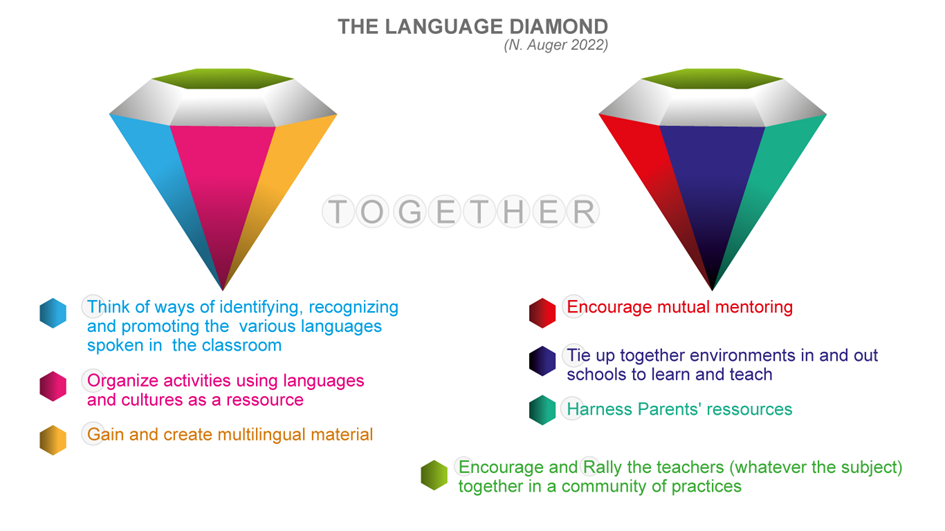
Each facet corresponds to intercultural practices that facilitate the transfer of individual resources toward new linguistic and cultural learning experiences (Cummins, 1976). The first letters of each facet form the acronym ENSEMBLE, emphasizing that true intercultural work relies on interaction between different people and statuses (teachers, students, parents, educational staff, external environments). This dynamic fosters a decentering process (Dervin, 2010) in which learning is not limited to students—instead, everyone is engaged in this educational process. These facets have been shaped by various national and international scientific projects (see bibliography), with no fixed time limit (Li Wei, in this issue). The facet Explore languages and cultures present in the classroom can be implemented through language biographies (Busch, 2006), whether oral, written, or artistic. Another facet involves Connecting languages during classroom activities, such as moving from one language to another (and thus practicing translanguaging [Li Wei]), comparing languages (Auger 2005), or engaging in meso- or micro-alternation (Gajo 2007). It is also important to work on the facet Encouraging the creation or acquisition of multilingual materials to recognize and concretely value, through various media, the languages and cultures present in the classroom by obtaining or encouraging students to bring books, manuals, or works of their choice, but also by having them create new materials, such as multilingual posters. The facet Training students to become peer tutors/mentors (encouraging mutual mentorship) aims to demonstrate that every learning path is valuable and that everyone can learn from one another. A student who struggles with the language of schooling may still have expertise in other languages or fields that are valuable to others—students, teachers, and educational staff at large. This facet encourages variation in interactive roles, alternating between symmetrical and asymmetrical interactions. These mutual tutoring approaches aim to deconstruct stereotypes about migrants or minorities, who are often perceived as “incompetent” or “dependent” and thus rarely placed in equal or authoritative roles within asymmetrical interactions. Another facet concerns Engaging external environments beyond the classroom, which strongly echoes Li Wei’s work on spatial and social divides. The school environment is not a closed space—learning and experiences occur in formal settings (school), informal settings (family), and non-formal settings (associations, cultural spaces, sports, leisure activities). It is important to recognize, value, and interconnect all of these practices by proposing formative trajectories that integrate different spheres and contexts in which individuals evolve and learn from one another. Various projects can be conducted in collaboration with museums, media libraries, and associations. Another facet highlights Building teaching and learning experiences with parents and family members. Families are often marginalized because they may not speak the language of instruction, may not be literate in any language, may have little formal education, and may be in an economically disadvantaged situation. This facet thus calls for recognizing the role of community and family, as in Li Wei’s work. It also encourages schools to include parents and create opportunities for them to share their resources and experiences through activities both inside and outside of school, such as participating in a multilingual museum visit. The facet that forms the foundation of the linguistic diamond is Linking teachers (across all subjects) within a community of practice. This highlights the fact that language teachers are not the only ones dealing with linguistic and cultural issues. Every subject area is embedded in linguistic and cultural practices specific to its discipline. The goal is for each teacher to share their expertise, learn from other teachers and educational staff, and feel part of a true community of practice, thus avoiding the isolation that some educators may experience.
It is clear that these different facets are not linear steps in a work program, but rather a framework for reflection and a set of suggested practices, inspired by various interrelated studies. Each facet is an hologram in the sense of Morin (1986 : 101). Indeed, each facet resonates with the others: “exploring languages” also entails “building with parents and family members,” and so on. The facets propose a synergy, a way of working through interconnecting in multiple ways, engaging with different interactants, contexts, and temporalities, so that each individual, in their singularity, can develop a plural identity (Lahire, 1998)—a complex and unique identity, whose construction nonetheless follows a universal process of formation through interaction.
Thus, this metaphor can be useful in various international educational contexts. Whenever teaching and learning are involved, language, languages, norms, and linguistic and cultural experiences come into play, regardless of the languages spoken or the subjects taught.
The Linguistic Diamond (DL) encourages engagement in artistic and craft-based creations, in project development and educational practices, as evidenced by the numerous films and videos documenting its use. Indeed, in any school setting, there are linguistic and cultural practices present, which can be examined, mobilized, and integrated. Le DL permet de prendre en compte la réalité de l’Humain avec ses expériences langagières et culturelles, plutôt que de le stigmatiser au prétexte que ses pratiques ne sont pas considérées comme légitimes, voire parfois même dangereuses pour le système scolaire (pas la « bonne » langue, pas la « bonne » culture). Dans ce sens, il s’agit d’un véritable acte de décolonisation. Le DL permet de reconnaitre, de valoriser, d’utiliser, de transférer, de mutualiser, de recycler pour encore apprendre et apprendre, qu’il s’agisse de langues ou de normes.
This representation can be complemented by the concept of language, norm, and cultural recycling (Auger, 2022), which illustrates the transformation process of experiences through misunderstandings, interferences, overlaps, and creative processes. When integrated into reflective activities, these elements help foster an awareness of the movement at work in all learning processes. Ultimately, understanding these learning mechanisms could enable individuals to develop meta-competencies that promote autonomy, self-awareness, and an understanding of linguistic and intercultural dynamics, which are at the core of human relationships. Within interactional processes, individuals can make inferences that allow them to decenter their perspective and gain an understanding of different viewpoints within context.
Recycling model regarding languages and norms –
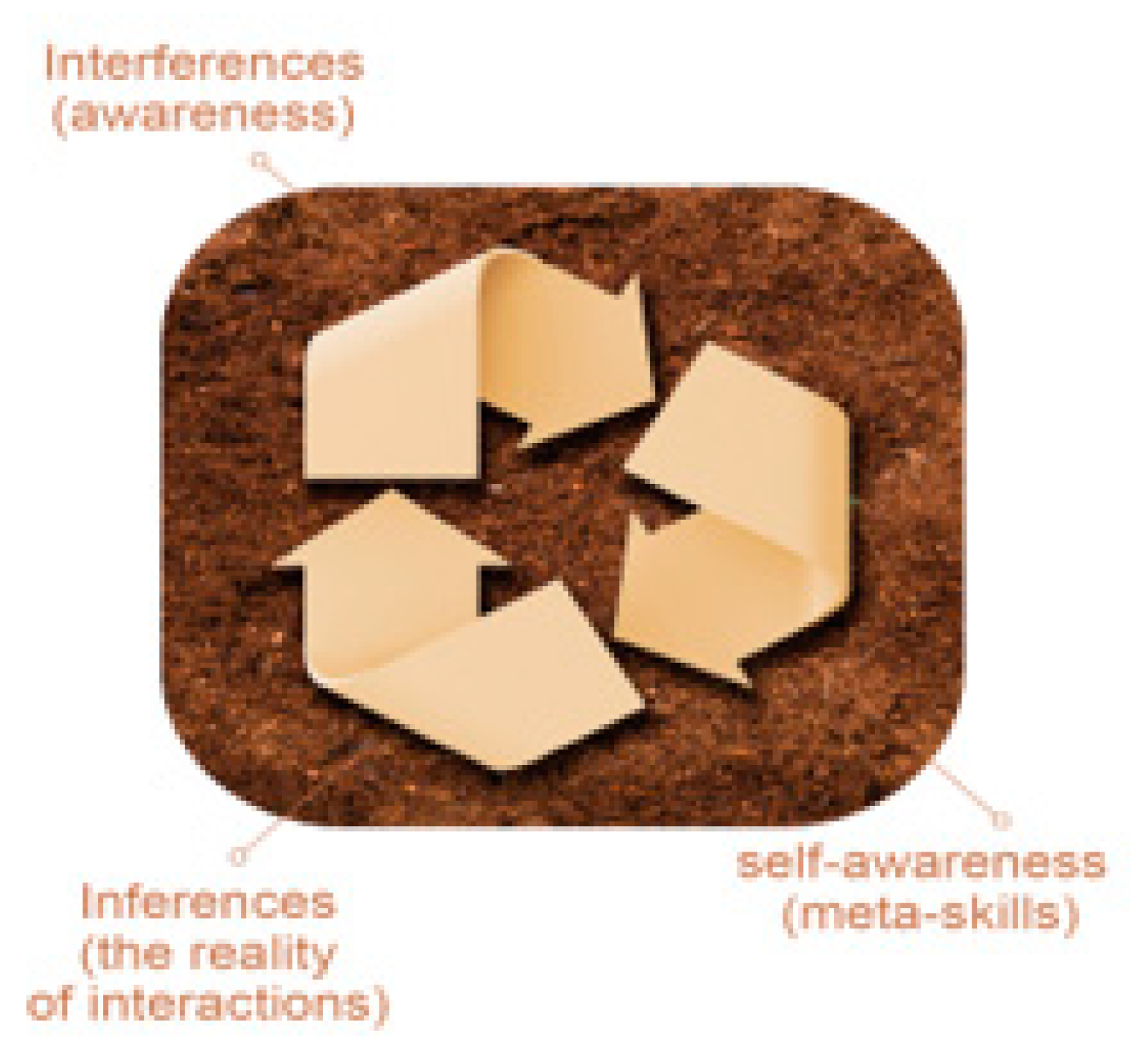
The representations of the Linguistic Diamond (DL) and the recycling of languages and norms serve as visual frameworks of interconnecting, acting as metaphors for plurilingual and intercultural education (Council of Europe, 2016). The challenge for anyone using these representations is not to rely solely on their own knowledge of linguistic and cultural experiences and their mechanisms in a way that imposes a transmissive approach on learners, but rather to remain engaged in questioning, understanding, and decentering their own practices, in order to fully experience the process of interconnecting.
The recycling of languages builds on existing knowledge about linguistic repertoires (Gumperz, 1971) and transfers between languages and norms (Cummins, 1976) to rethink language teaching and learning (through languages). Following Lavoisier’s principle—“Nothing is lost, nothing is created, everything is transformed” (1789)—this approach establishes a connection with the Möbius strip, first developed by mathematicians August Ferdinand Möbius and Johann Benedict Listing in 1858. The connection with the humanities and social sciences was immediate, and the Möbius strip was adopted as a symbol of recycling as early as the 1970s.
This idea of endless recycling has inspired numerous fields in the human and social sciences, such as psychology and anthropology. It has contributed to the development of a theory of social and cultural identity that challenges the notion of the self and the environment as distinct entities. This interrelation has also enriched many theories on language development, linking social contexts, language, and identities (see Bronckart, 1996/2022, for a synthesis of Socio-Discursive Interactionism).
Thus, when an error occurs, if it is considered as a collision of languages or norms, an interference, it becomes possible for both students and teachers to become aware of a border-crossing (-trans). This type of activity, whether spontaneous or planned, fosters a general awareness of these processes within the classroom (Auger, 2021b). Both students and teachers can infer the reason for this collision—for example, differences in phonological systems, lexical similarities but divergent semantic evolution, and so on.
The recycling of languages and norms does not only involve units that need to be transformed but also those that transfer automatically (such as shared lexicon, equivalent structures and syntax, or morphological similarities). Whether preserving units or transforming them, recycling fosters self-confidence, reinforcing the idea that each linguistic repertoire can support new learning experiences. This notion of welcoming linguistic productions rather than stigmatizing them is also reflected in the idea of gentleness in “soft recycling”, as expressed in the phrase “soft and sustainable recycling.”
Furthermore, beyond the circular nature of recycling (and its well-known symbol), the Möbius strip also introduces the less familiar notions of interior/exterior, as its front and back blend together, becoming visible in turn. This representation is particularly significant for the social sciences, extending far beyond a cybernetic feedback/loop model. Indeed, it is precisely through interactions within specific contexts (exterior) that these collisions of linguistic and cultural practices (interior) emerge.
The recycling of languages and norms serves as a metaphor that can help make the processing mechanisms involved in language learning more intelligible. Just like traditional recycling, it allows for the reintroduction of certain materials—here, linguistic elements (transfers)—into the production of new idioms. The units (recyclable materials) include sounds, lexicon, syntax, mime-gestural expressions, but also representations, and more.
Recycling has various implications for the classroom ecology, which also extends to families.
Pre-existing knowledge is no longer seen as a pollutant that stigmatizes students but rather as “fuel” for learning. This “fuel” stands in opposition to the notion of scarcity, which recycling seeks to eliminate. When considering students’ linguistic repertoires, what may initially appear as a lack of resources actually conceals numerous possibilities for transfers and recycling.
There is also a form of preservation of “already-there” resources (the linguistic units already present), which further supports confidence in one’s abilities and self-esteem. Finally, even though the recycling of languages and norms requires pedagogical investment, it ultimately proves beneficial for learning and emotionally reassuring.
To avoid concluding and to continue interconnecting
This response to Li Wei has demonstrated that relying on the notion of reliance in epistemology creates new opportunities for reflection within diverse and unique publics, where the concepts of identity, race, community, and “trans-” can be connected to Francophone contexts and vice versa, fostering the development of a panlinguistic approach that accounts for the variety of contexts and speakers. Classroom methodologies can then integrate the recycling of languages, enabling the development of each student’s linguistic diamond, with the ultimate goal of achieving the greatest possible equity in learning.
Aden, J., 2013, « De la langue en mouvement à la parole vivante : théâtre et didactique des langues », LANGAGES : Le vécu corporel dans la pratique d’une langue, no 192, pp. 101-110. https://shs.cairn.info/revue-langages-2013-4-page-101?lang=fr
Auger, N 2005. Comparons nos langues. DVD et livret d’accompagnement, Scéren. https://www.youtube.com/watch?v=_ZlBiAoMTBo
Auger N., 2010, « Le français, cette autre langue à comparer. Une question en miroir : l’apprentissage et l’enseignement du français aux Élèves Nouvellement Arrivés en France (ENA) », Enseignement et apprentissage d’une langue étrangère. Impacts sur la langue maternelle, C. Corblin & J. Sauvage (dir.), L’Harmattan, coll. Enfance et langage, pp. 79-96.
Auger, N., 2020a, « “Translangaging” ou comment prendre en compte toutes les langues des élèves pour une meilleure réussite de tous », School education gateway, Commission européenne, https://school-education.ec.europa.eu/en/discover/news/translanguaging-how-take-account-all-pupils-languages-improved-results (traduit en 6 langues)
Auger, N., 2020b, « Examining the Nature and Potential of Plurilingual Language Education: Toward a Seven-step Plurilingual Language Education Framework » in Plurilingual Handbook in Language Education, edited by Drs. Enrica Piccardo, Aline Germain-Rutherford and Geoff Lawrence, Routledge, pp. 465-483.
Auger, N. (dir.), 2021a, Enfants gitans à l’école et en famille. D’une analyse des dynamiques langagières en famille aux pratiques de classe, ENS édition, coll. Éducation et savoirs en société.
Auger, N. 2021b, « De “Comparons nos langues” (2003) à “Suivez le guide !” (2021) ». Parcours de recherche en langues sur près de 20 ans, à l’école et en famille », In É. Oger, A. Maravelaki, C. Hayez, Le language et l’homme, EME, Vol. 56, no 2, pp. 115-130.
Auger, N., 2022, « Conscience collective et autoconscience dans l’enseignement / apprentissage du français langue seconde et de scolarisation : quand l’interculturel et le plurilinguisme sont en jeu », Glottodidactica An International Journal of Applied Linguistics 49 (1), Adam Mickiewicz University Press Poznan, p. 35-51. DOI:10.14746/gl.2022.49.1.03
Auger, N., 2023a, « Les langues des familles, des langues d’assez bonne “qualité” pour l’école ? Retour sur les représentations enseignantes », Glottopol [En ligne], 38 | 2023, mis en ligne le 01 janvier 2023, consulté le 28 juin 2023. URL : http://journals.openedition.org/glottopol/2980 ; DOI : https://doi.org/10.4000/glottopol.2980
Auger, N. 2023b. « The Language Diamond: An Intercultural Model to Teach and Learn (through) Languages ». Education Sciences, 13(5), 520. https://doi.org/10.3390/educsci13050520
Auger, N., Guiraud, F. & Tran Mugnier, D.-A. 2023. « Territoire apprenant : une ambition éducative à l’épreuve de la réalité du terrain au travers du projet international Sirius (Éducation et Migration) », revue RELAIS, 205-239.
S. Babault, M. Bento, 2023, Pratiques translangagières dans l’enseignement-apprentissage des disciplines en contexte bi- ou plurilingue, revue LIDIL, 67 | 2023.
Bronckart, J.-P. 2022. Activité langagière, textes et discours. Pour un interactionnisme socio-discursif. Limoges : Lambert-Lucas [Première édition, 1996].
Bulletin officiel du ministère de l’Éducation nationale du 22 juillet 2004, numéro 29, Intégration des élèves handicapés. Organisation du service départemental d’auxiliaires de vie scolaire - rentrée 2004. NOR : MENE0401590C
Bulletin officiel du ministère de l’Éducation nationale du 11 octobre 2012, numéro 37, Scolarisation des élèves. Organisation de la scolarité des élèves allophones nouvellement arrivés circulaire no 2012-141 du 2-10-2012 (NOR : REDE1236612C).
Busch, B. 2006. Language Biographies - approaches to multilingualism in education and linguistic research. In B. Brigitta, A. Jardine, A.Tjoutuku. Language biographies for multilingual learning. Cape Town: PREAESA occasional Papers. No. 24, 5-17.
Candelier, M., 2005, « Approches plurielles, didactiques du plurilinguisme :
le même et l’autre », Recherches en didactique des langues et des cultures [En ligne], 5 | 2008, consulté le 19 janvier 2025. URL : http://journals.openedition.org/rdlc/6289 ; DOI : https://doi.org/10.4000/rdlc.6289
Chiss, J-L. 2022, Idéologies linguistiques, politiques et didactiques des langues. Limoges, Éd. Lambert-Lucas, coll. Linguistique et sociolinguistique.
Cummins, J. 1976, « The Influence of Bilingualism on Cognitive Growth: A Synthesis of Research Findings and Explanatory Hypotheses », Working Papers on Bilingualism, no 9.
Cummins, J., Early M. 2010, Identity Texts: The Collaborative Creation of Power in Multilingual Schools, Trentham Books Ltd.
Conseil de l’Europe (2016), Guide pour le développement et la mise en œuvre de curriculums pour une éducation plurilingue et interculturelle, https://www.coe.int/fr/web/platform-plurilingual-intercultural-language-education/home
De Pietro, J-F. 1995. Vivre et apprendre les langues autrement à l’école - une expérience d’éveil au langage à l’école primaire. Babylonia, (2), 32-36.
Dervin, F. 2010, Pistes pour Renouveler L’interculturel en Education. Recherches en Education [on line], 9|2010, mis en ligne le 01 novembre 2010, December 2022. Available online: http://journals.openedition.org/ree/4599 (accessed on 27 April 2023)
Eschenauer, S. 2014. « Faire corps avec ses langues. Théâtre et didactique : vers une définition de la Translangageance ». E-CRINI - La revue électronique du Centre de Recherche sur les Identités Nationales et l’Interculturalité, Actes du colloque Langues en mouvement, Languages in Motion, 6, pp. 1-24.
Gajo, L. 2020, « Didactique des langues et didactique du plurilinguisme : continuités, complémentarités,ruptures » in S. Gola, M. Pierrard, E. Tops et D. Van Raemdonck (dirs.), Enseigner et apprendre les langues au XXIe siècle. Méthodes alternatives et nouveaux dispositifs d’accompagnement GRAMM-R, Peter Lang, Vol. 47.
García, O. 2008. Bilingual Education in the 21st Century: A Global Perspective (1st edition). Wiley-Blackwell.
Garcia, O., & Wei, L. 2014. Translanguaging: Language, Bilingualism, and Education. New York, NY: Palgrave MacMillan.
https://doi.org/10.1057/9781137385765
Gumperz, J. John, 1971, « Bilingualism, Bidialectualism and Classroom Interaction », In The Functions of Language in the Classroom, C. Cazden, V. John and D. Hymes (dir.), New York, Teachers College Press.
Hawkins, E. 1987, Awareness of language: An introduction (revised ed.). Cambridge University Press.
Jambes, J. -P., 2001, Territoires apprenants. Esquisses pour le développement local du XXIe siècle. L’Harmattan.
Lahire, B., 1998, L’homme pluriel. Les ressorts de l’action, Paris, Nathan.
Li W., Zhu, H., « Translanguaging Identities and Ideologies: Creating Transnational Space Through Flexible Multilingual Practices Amongst Chinese University Students in the UK », Applied Linguistics, Volume 34, Issue 5, December 2013, p. 516–535, https://doi.org/10.1093/applin/amt022
LOI (République française) n° 2019-791 du 26 juillet 2019 pour une école de la confiance.
Miquel, F., 2020, Quand les élèves nous élèvent De nouvelles voix éducatives, coll. Enfance et Langages, Paris, L’Harmattan.
Moore, D. 2006, Plurilinguismes et école, Paris, Didier, coll. Langues et apprentissage des langues.
Morin, E. 1980. La méthode, Tome 2, La vie de la vie, Paris, Seuil.
Morin, E., 1986. La méthode, Tome 3, La connaissance de la connaissance, Paris, Seuil.
Perregaux, C. (1995). « L’école, espace plurilingue », Lidil 11, pp. 125-139.
Py, B., 2006, « Cavalli, Marissa (2005), Education bilingue et plurilinguisme, le cas du val d’Aoste », Bulletin Suisse de linguistique appliquée, n° 83/1, 2006, Neuchâtel, Institut de linguistique de l’Université de Neuchâtel, pp. 169-171.
Sauvage, J., Auger, N. 2022, « Familles migrantes en situation précaire, fracture numérique et éducation formelle, informelle et non formelle. L’exemple du projet SIRIUS à Montpellier » In P-O Weiss & A. Maurizio. L’Éducation aux marges en temps de pandémie : précarités, inégalités et fracture numérique, Presses universitaires des Antilles, pp. 181-208, 2022, ⟨10.3917/pua.weiss.2022.01.0181⟩
Varela, F. J. 1999, « Quatre phares pour l’avenir des sciences cognitives », Revue Théorie, Littérature, Enseignement, no 17, Dynamique et cognition : nouvelles approches, Presses Universitaires de Vincennes, pp. 7-23.
Williams, C. (1994) Arfarniad o Ddulliau Dysgu ac Addysgu yng Nghyd-destun Addysg Uwchradd Ddwyieithog, [An evaluation of teaching and learning methods in the context of bilingual secondary education]. Unpublished Doctoral Thesis (University of Wales, Bangor).
[1] « interconnecting » is our own translation of Edgar Morin’s (…) conception of “reliance” refering in French to the notion of “link work' or 'making links”. For Morin, we need a “theory of generalized interconnexion (bewtween science and citizens, between citizens, between separate knowledge. The suffixe “ing” reinforces the actions of the subjects toward interconnection. This concept also refers to the faculty of the mind, which is to articulate what is separate and to connect what is disjoint to distinguish forms or patterns without cutting them up, and to identify the
patterns without cutting them up, and to identify the “thirds” or “binders” between them. is this not also what we now mean by the faculty of interconnecting? (Le Moigne 2008 lemoigne.pdf)
[2] https://www.canal-u.tv/chaines/ut2j/compalangues-2021/modelisation-theorique-et-ressources-pour-les-enseignants-de-la-0
[3] Le Conseil Supérieur des Langues « Favoriser le plurilinguisme en s'appuyant sur les acquis d’une langue à l’autre » https://www.education.gouv.fr/le-conseil-superieur-des-langues-327011
[4] Could be translated : “When students lift us up. New educational voices”.
[5] https://siriusfrance.jimdofree.com/
 Contacter l'auteur
 Lire la suite